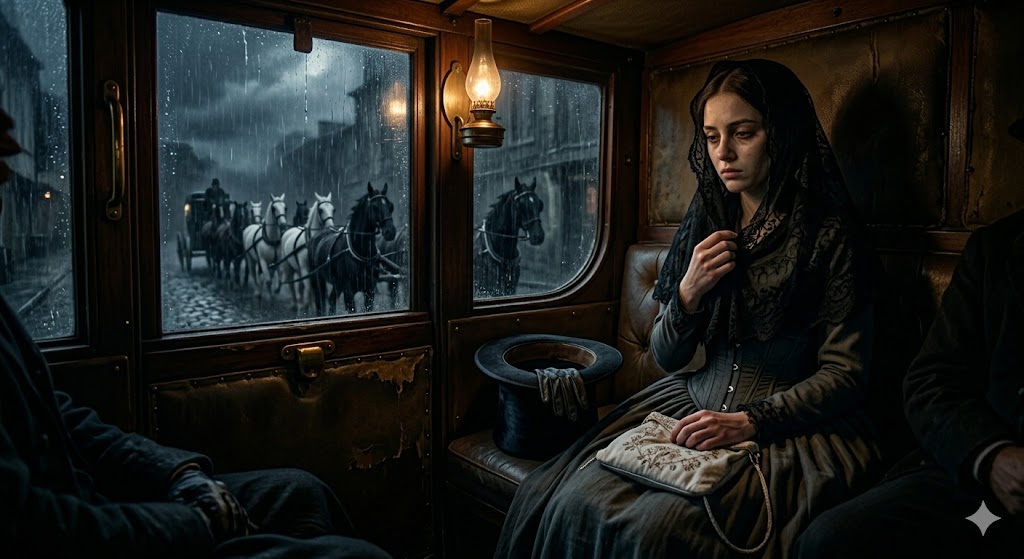
I am sitting facing the direction of travel in a diligence-style stagecoach drawn by twelve horses, six black and six white. My gambler-style beaver-fur top hat, which I removed with a polite request for permission, rests upside down on my knee along with my black rabbit-skin gloves and my cloak inside it. Though I occasionally glance at the changing scenery through the window, my eyes are mostly drawn to the tired face of young Miss Tahabes. She sits in silence, burdened by the weariness of the road and the journey, the discomfort of the crinoline inside and the corset gripping her waist tightly, tugging at the strap of her white embroidered bag, and occasionally toying with the lace of the mantilla on her head.
I have not counted how many times day and night have passed outside; how many times we have stopped for the horses, for us two passengers, or for the human needs of our driver, Mr. Autrom, who remains as emotionless and silent as a grave in both body and temperament even as he whips the horses. Throughout our journey—which kept us as far from mortals as possible across snowy mountain peaks, sand dunes where we got bogged down, roads blocked by floods, and lush green meadows—we had chosen not to converse, but rather to know one another by observing, or to remain silent based on the judgments we formed from those observations.
The carriage ground to a halt in the middle of a snowy plain as Mr. Autrom slammed on the brakes. From the sounds above, we gathered that he was climbing down. A moment later, he opened the door and, with an expression like a tombstone, spoke as if I were not even there.
“Miss Tahabes, we will pause here for a while; after this, we shall not be able to take a break for a long time,” he said.
To cross yet another threshold of patience, Miss Tahabes took a deep breath, gathered her skirts, and stepped out onto the snow. Then, draping my cloak over my frock coat and putting on my hat and gloves, I alighted from the carriage. I took out my pocket watch and checked the time. 19:00.
As our carriage stood there in the very center of the endless plain as if abandoned, the three of us drifted apart in different directions, leaving our footprints in the snow.
I was trying to understand both the reason behind what Mr. Autrom had told Miss Tahabes, and why he had acted as if I already knew and didn’t need to be told. Miss Tahabes, for her part, did not seem to mind the fact that we would not be taking another break for a long while. She had simply accepted it and begun to make use of her time.
Miss Tahabes turned to look back, ensuring she had walked far enough. Even though the stagecoach and the horses had become mere specks against the white backdrop, she must have still felt she wasn’t at a safe distance; her steps quickened, then grew aggressive. She distanced herself even further, carving a wide trench in the snow. She thought of Mr. Oahc, who would acknowledge her with forced politeness and a nod as they re-entered the carriage after each break, only to sit through the ceaseless, days-long stretches of the journey without uttering a single word, his eyes never leaving hers. Her cheeks flushed with an inexplicable anger rising within her. “I hope he gets eaten by a monster wherever he goes this time,” she thought, but then felt ashamed, unsettled by the unnecessary harshness and injustice of her own wish. Then, she pondered the sheer absurdity of the man’s name. “What does Oahc even mean?” From what she had overheard in conversation, Mr. Autrom had also been curious about this. What had Mr. Oahc said? “They have always claimed I had a name.” Yes, that was what he had said, rather insolently. In response, Mr. Autrom had not pressed the matter, simply climbing into the driver’s seat to set off.
Mr. Autrom, with his long face hidden beneath a tall top hat, a beard that only wrapped around his chin, and eyes trapped in deep hollows on either side of his aquiline nose, was also wading through the snow, parting it just like Miss Tahabes and Mr. Oahc. Aside from a black tailcoat, a waistcoat, and a carelessly tied black cravat bringing together the collars of his white shirt, he wore nothing else to shield him from the passing seasons. He was entirely aware that he was exceedingly gaunt, exceedingly tall, exceedingly hunched, and exceedingly vulture-like. That was why he preferred to be on top of the carriage rather than inside its comfortable confines. He had earned renown in his own world by delivering his meticulously chosen passengers to wherever they desired to go, no matter the destination. Mr. Autrom was not a talkative man. As always, he had sensed danger and, as a precaution, stopped at the safest possible point. “According to my calculations, a storm will break at 19:14,” he muttered to himself. Tilting his head up toward the sky, he inhaled the frigid air and added, “A far greater one will break at 19:39.”
Reaching into his waistcoat pocket, he pulled out his pocket watch and checked the time: 19:04.
Miss Tahabes from the south, Mr. Autrom from the west, and Mr. Oahc from the north traced their footprints back, each walking from the direction they had come toward the central point they had left behind. That is, until they spotted two dark silhouettes approaching them from the south. All three stopped in their tracks; the silhouettes to the south seemed to have stopped as well. As if by an unspoken agreement, the three of them took seven steps forward, and the silhouettes matched them. By the time they reached the carriage with cautious steps led by Mr. Autrom, the figures had become clear: two robust boys around eight years old, one with a dark complexion and the other fair, each holding a bouquet of roses. The boys’ hands were swollen, red, and stiff from the cold. The capillaries on their cheeks had burst, leaving the skin above their cheekbones bruised purple. Mr. Autrom walked over to the children and returned with a graveyard on his face far gloomier than usual. First, he went to Miss Tahabes and murmured something in a tone I could not hear; I noticed she merely tugged at the lace of her mantilla instead of replying. Rebounding from Miss Tahabes like a skipped stone, Mr. Autrom altered his course toward me. Staring directly into my eyes, he said, “Mr. Oahc, these children are bound for 20:18.”
I imagine my eyes widened in astonishment. “Are you certain, Mr. Autrom? I don’t believe anyone has ever managed to go as far as 20:18 before, let alone mere children,” I said.
“Mr. Oahc, this requires your consent—yours and Miss Tahabes’. And they have a request: they wish to sit side by side.”
This meant I would no longer be able to watch the scenery I had observed throughout the journey. I found myself torn between my distaste for change and the moral weight imposed on me by the length and hardship of the children’s journey. I despised both change and moral burdens. Furthermore, since Mr. Autrom had saved my vote for last, he must have already secured Miss Tahabes’ approval.
“Their names?” I asked.
“I don’t know if it makes a difference, but I shall ask,” he said, slowly walking away from me.
A moment later, he first went to Miss Tahabes, relayed the information to her, and then approached me, stating that the children’s names were Neven and Natan.
I lean my shoulder against the left window of the carriage facing forward. Miss Tahabes sits with proper decorum, her head turned slightly to the right. The “vav” tattoo on her neck catches my eye for the first time; it must represent an oath she is trying to remember, one she struggles to keep. Neven is seated opposite me, his shoulder against the glass like mine, while Natan’s shoulder rests against the other window.
Natan raises the bouquet in his left hand with a deft flick of the wrist, moving the fingers of his right hand as if counting the roses; he is undoubtedly making some calculations in his head. With the same gesture, Neven lifts his roses to the level of his own face, briskly brushing his other hand over the red velvet blossoms, allowing the fragrance to envelop the entire carriage. The thought that one of them might soon commit an indiscretion by insisting I buy a rose for Miss Tahabes makes me sweat. I loosen my cravat.
A single rosebud is thrust right under my nose. Natan acted fast.
Miss Tahabes must be wondering how I will pass this test, as her eyes are fixed on the silent exchange between Natan and me. I pull a banknote from the wallet in the inner pocket of my frock coat and hand it over. The rose is in my hand. Now Neven and Natan are waiting to see what I will do. I am not insolent enough to offer the rose to Miss Tahabes right now. Instead, I place it upright inside my hat, right next to my gloves. The red head of the rose rests there, leaning out from the brim of the hat toward Miss Tahabes like a stretching kitten. Assuming everything goes well according to Mr. Autrom’s prophecy, I will encounter Miss Tahabes again with much greater affection at 20:19, so I don’t believe there is any need to rush into conversation. Of course, this time frame coincides with a moment long after she departs the carriage, and it remains a secret between Mr. Autrom and me.
They say Mr. Autrom gives each of his passengers a secret during every journey, and this was the secret that fell to my lot. It is worth noting that his prophecies hold true. The gloom of the storm that broke at 19:14 was so suffocating that until 19:18, an immense weight rested heavy on our chests. As for the storm that started at 19:39, it finally subsided at 19:45 after the sky erupted one last time. The heavens’ wrath had waned, and the storm had given way to cold winds.
I alighted from the carriage at 19:74, precisely at the moment I was supposed to disembark. Miss Tahabes and the children continued on their way under Mr. Autrom’s command. I left my hat, my gloves, and the rose inside it with Miss Tahabes, so she might remember me in the future.
She forgot…
Yazan: Chaotica
Çeviri: Umberto

