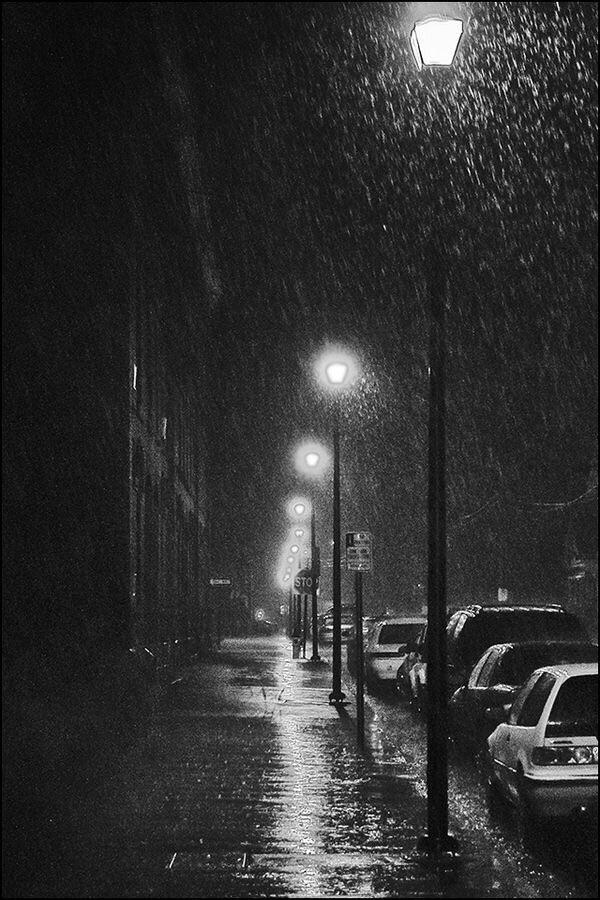
It was the twelfth year of the rain. The room was blanketed with the corpses of photons that had dashed themselves against the window and died. Though I could not see the steam hissing from the spout of the navy-blue enamel kettle on the stove, I could hear it. In my absence, Polina had adopted a tabby cat and named it after me. “Chao,” she would call out to it with tender affection.
“Would you like some more?” she asked, gesturing to the half-emptied bottle of whiskey.
I nodded in a way that meant “Yes” and held out my glass.
“Your absence lasted long,” she said, pouring the drink.
“I haven’t arrived yet, Polina; I’m still there. Lying in that waterlogged trench that shrivels my fingers, waiting for the war with myself to end. Ah, my other half! She still cannot see that I was defeated long ago, and that if she came and took my life, she wouldn’t even notice.”
She rose from the edge of the chair where she always sat as though ready to spring up at any second, moved over, and sat beside me. With a thumb moistened by her tongue, she smoothed my disheveled brows, cupped my chin, drew me gently toward her, pressed a tender kiss to my cheek, and asked in a voice steeped from deep within: “Tell me whatever happened. You take refuge in me because I am your haven, and then you run off like a rabid dog, only to return years later. Tell me whatever happened.”
* * *
Back then, just outside Ferslev, my wife Barbara, my five-year-old son Francisco, and I were scraping by through farming in a small cottage, living alongside a few chickens, a few goats, sheep, and a cow. The poems I wrote mostly by candlelight, I would gather up on weekends when taking our goods to the town market; instead of shouting to sell eggs, cheese, or rye bread, I would climb atop the stall and bellow my poems at the top of my lungs. The verses filled with barbed barbs aimed at the King, Napoleon, and the Duke were met with derision by the market folk, yet the false cheers brought in real hard coin. As for my love poems, they seized women by their very lungs, drawing awestruck gazes and misted eyes upon me.
One day, she appeared before the stall. Her butterfly lips, her translucent skin, her eyes weary from looking too beautifully… I couldn’t tear my gaze away. Just as it is a wretched disgrace for a man to betray his wife, it was equally unjust of God to test a man with a woman far superior to his own. I tossed the penury-choked pages of my verse to the back, dragged my love poetry to the fore, and recited them straight into her eyes. When the fire that fell into my manhood began to stiffen the front of my ragged trousers, I clumsily vaulted down from the stall. Whispering her name while pressing a pierced silver coin into my palm, she murmured: “Kristin…”
I hadn’t even been able to say my own name as she melted into the crowd. Would I ever see her again? God knows. I loaded the unsold goods onto the cart and set off for the market in Svenstrup. By the time I returned home, I would have forgotten. That was the kind of man I was; I see the moon and worship the moon, I see the sun and worship the sun, I see a cat dozing lazily on a stool and worship it. Who knows whom I would wake up loving come the next day?
It turned out not to be like that at all. As I chewed sour bread dipped in beer, I thought of her; while pissing among the bushes, I thought of her; while whipping the horses, I thought of her; while opening the stall, I thought of her; while tilling the earth, I thought of her. Days passed, and I was writing poems for Kristin alone. The tallow and candles in the house melted away alongside me for Kristin’s sake, and my transformation did not escape Barbara’s notice. While she, with her tiny frame, chased after our mischievous son Francisco, striving single-handedly to keep the household and the animals afloat, I poured my energy into harvesting—pursuing oxen—just to forge the most striking line.
When I went to the festival in Norholm, I carried only my love poems. I told Barbara that my satirical verse had landed me in trouble, that I was being investigated by the church, and that with the informers at work, I might not keep my head upon my shoulders much longer. The poor woman was frightened. Good or bad, scattered as I was, she had a husband. Raising Francisco all alone—what a crushing burden that would be. Perhaps her family, seeing her widowed by such cause, would panic and say, “Manage however you can.” Barbara herself said to me, “Be careful, Chao; if I am left a widow at this age, I’ll be cast into the streets. You wouldn’t want our son to have a mother fallen into ruin, surely.”
I didn’t have enough wits about me to see the road ahead; my mind, my body burned and blazed for a woman I had seen but once, for the span of a few poems. The sole purpose of those love poems was to tell Kristin of my passion the next time I laid eyes on her.
Behind the cluster of starstruck, teary-eyed women gathered before the stall, I felt someone’s gaze upon me. It was her. She stayed by my side until dusk fell on the first night of the festival. She listened to my poetry; save for her plump companion, there was no one else around—she must have been waiting for me. After draping rags over the stall and entrusting our odds and ends to the guild’s security, I went over to them.
I was grinning from ear to ear, incapable of playing hard-to-get with my happiness. I suggested we head down to the tavern of the inn where I had taken a room and get something to eat. She agreed. She spoke, and I spoke. As words tumbled from her butterfly lips, her dreamlike voice seemed to filter out from a locked box of sorrow. Every now and then, her plump companion would also murmur praises for my poetry, wondering by the grace of which angel I had penned such lines.
When the hour grew quite late, her plump companion had gone off to their shared quarters, and Kristin and I had climbed up to my room. It smelled of water. Her translucent skin smelled of ocean. No sweat, no rotting cabbage, no mackerel, no beer… Until the first light of dawn, over and over in every possible way, we became each other’s. This ought to have quenched my fire; no, it did not.
* * *
“Won’t you tell me?” Polina asked.
“Tell you what?” I asked.
“Everything… Whatever happened to you…”
After refilling my glass, she rested her butter-yellow-haired, lovely head against my shoulder. Her misty, hazel-grey eyes were fixed on the reddening stovepipes.
Outside, thunder rumbled, windows shuddered; we were too drunk to shudder.
* * *
The next morning, Kristin packed up and returned to Bonderup. Her plump companion’s business wasn’t finished yet. Since Kristin was the common thread between us, I figured it was only polite to spend time with her friend at the inn after the market closed. Kristin would surely appreciate this gesture, thinking me a gentleman for looking after the companion who had accompanied her all the way to Norholm. Her name was Marian. A short while after praising my poetry, she began talking about wars and their repercussions; under the influence of the beer I’d drunk, my lingering love for Kristin twisted into something else entirely. We went up to my room together. When morning broke, Marian said, “I’m going to have trouble sitting down for a while,” and planted a long, sensual kiss upon my manhood.
Only then did I grasp what I had done. I was in love with Marian, too, and she with me. What would happen to Kristin? Nothing; the love inside me was enough for both, my poems were enough for both, I was enough for both. While Francisco swung back and forth on his wooden horse over the turf, thrusting his toy sword, and Barbara struggled to bring back the milk she had milked without spilling a drop, that question suddenly struck my mind while I was framing verses for both Kristin and Marian: What if Kristin finds out I’ve been with Marian too? The first thing that ought to have been considered had occurred to me days later. I didn’t know the answer; if I saw her again and she had found out, I would learn it then. Marian was Kristin’s closest friend, and Kristin was Marian’s. Their childhoods had been spent together, they had shared virtually everything. Me included. I knew this chaos would end with both of them abandoning me. I would be left face-to-face with my deep sorrows. I was certain I would commit suicide without Kristin and Marian. Love meant them. Barbara sensed the change in me, wept, and when she couldn’t reach me, cried out, “It’s me, Barbara, your childhood sweetheart!”
She was right; she was my childhood sweetheart. Until Kristin, the thought of betraying, humiliating, or cheating on her had never crossed my mind, my heart, or any part of me. I worshipped our son Francisco. The pleasure offered by the greatest love or lust was a mere nothing beside a single minute spent with my son. Yet things were shifting; the Battle of Towton was starting up inside me all over again. Every day, looking into those misty eyes with the stings of a guilty conscience; every time my son uttered the word “father,” sinking into the earth with shame; unable to look God in the eye, certain that if I repented I would only sin again… The war had begun long ago, and my virtuous side lay already dead.
The weight of these thoughts spilled over into my poetry. It was no longer merely love, but drama, religion, love, virtue… Everything was in my verse. Wide crowds began to follow me. In exchange for the money they paid for my poems, I gifted them loaves of bread baked by Barbara’s tireless hands. Free bread alongside poetry had swelled my customer count. Whenever I descended to the marketplace, I even managed to mail off the love letters I’d written to Marian and Kristin. Reading those letters back to myself, even I fell in love with me—how could they not? Thus, I dreamed up a formula where neither Marian nor Kristin would abandon me.
One day, I intercepted a letter that arrived right on time, beating Barbara to it. The letter was from Kristin. She had abandoned her friend, not me. Did this mean she wasn’t angry with me? Would I be able to be with my plump lover Marian whenever our paths crossed, and live out our love to the full? There was no knowing the answers to these questions. Nor could I ask Kristin to find out. I would act as circumstances dictated; since she had left, I would abandon Marian too. An honorable man would do that. As for that uncontainable, immoral streak within me—it was still passionately in love with Marian and yearged to quench its lust between her fat thighs at every chance, whenever everyone else was looking the other way.
I was the crazed lover of the market stalls, peddling bread, cheese, and poetry. My mind, my thoughts, my everything were wrapped up in Barbara, Francisco, Kristin, and Marian—right up until Klara, who tried to seduce me with her ocean-blue, sensual eyes. Though it was impossible for such an intense love to weather such flagrant infidelity, I found myself spending the evening in Klara’s bed. Klara shrieked and cried out during lovemaking, doing every unusual thing imaginable, tearing all rules of decency to shreds. I couldn’t believe I’d survived to the morning after the countless times we tangled. I could have died for Klara. I was in love with Klara, too. Lying stark naked like a defiled corpse in that filthy room, upon that filthy bed, amid reeking sheets, staring up at the leaking ceiling, the final scrap of humanity inside me tore through its membrane and screamed out: “Get up, you hell-spawn of God, get up and look at what you’ve done.”
The voice was right, but I was in love. How could I have known when love would strike, whipping up storms and kindling fires within me? I could have died for Klara, for Marian, for Kristin. Right then, at that very moment. If only someone had asked me to, so I could have died. I didn’t die.
Leaving Klara deep in sleep in the bed, I hurried out and hitched the horses to my cart. I wanted to turn over a new leaf at last. Damn Klara, damn Marian, damn Kristin… I wanted to go home, to embrace my child Francisco, to wet his rags with my tears, to drink beet soup from Barbara’s hands. This time I was resolute. If need be, I would give up poetry and sell nothing but bread and cheese in the marketplaces where I had been a jester.
* * *
“Polina, are you asleep? You wanted me to tell you,” I said.
“Yes,” Polina said, shifting up slightly to stroke my hair, kissing my temples and my eyes.
* * *
As I was hitching the horses, a monk-like figure draped in a brown hooded robe approached me just as I was about to move off, and said in a thin, polite voice, “Mr. Chao, I’m an admirer of your poetry. You’re sincere, warm, and original.”
The love-demon inside me had already perked up its ears: “Thank you.”
“I’d be grateful if you could drop me off near Dall,” she said, adding, “I’m Sylvia.”
“Of course, Sylvia, hop in,” I said politely.
A few hours later in the woods, Sylvia and I were making promises we couldn’t possibly keep to one another. I could have died for Sylvia, I should have. She deserved love in its highest form—after Kristin, Marian, and Klara, of course.
When Sylvia got down at Dall, I promised I would write to her. We bid farewell to yearning, longing, and love. Sylvia wasn’t all that far away; every now and then I could go and show her what I could accomplish with my love. Her young, taut skin was dark and possessed a vigorous beauty.
When I reached Ferslev, our cottage was visible in the distance, and my son could even be seen playing in front of it. As I drew closer, I realized Francisco was crying at the door. I vaulted from the cart and ran to embrace my son: “What is it, Francisco?”
With his tiny finger, he pointed toward the inside of the house.
I went inside. With her misty eyes wide open, Barbara was hanging from the ceiling beam, having left a small note behind: “I know everything,” it read.
I searched for the incoming letters; no letter had arrived. Who could have told her?
The voice rising from inside me—whose was it, I know not: “I told her everything, before I set out.”
Whether this voice belonged to the love-demon or my conscientious side, I did not know. I knelt down by Barbara’s dangling legs and embraced them. I had never cried so much in my life; crying brought a sense of relief that unsettled me even more, but I couldn’t stop it. Once my shoulders had finished shaking as I wept, hugging my son, I finally calmed down. I climbed onto the table and cut Barbara down. After calling the priest and taking care of the necessary rites, as I threw earth onto her coffin, I was already making plans to go to Kristin; if not her, Marian, Klara, or Sylvia—what difference did it make? Love is the same love, Chao is the same Chao…
* * *
The sound of thunder, crashing as if it would shatter the glass panes almost, jolted Polina out of her skin. There had been no lightning. I held Polina tight. “You’re so wonderfully silent,” she said in her raspy voice…
“I can only tell you everything this way,” I said.

