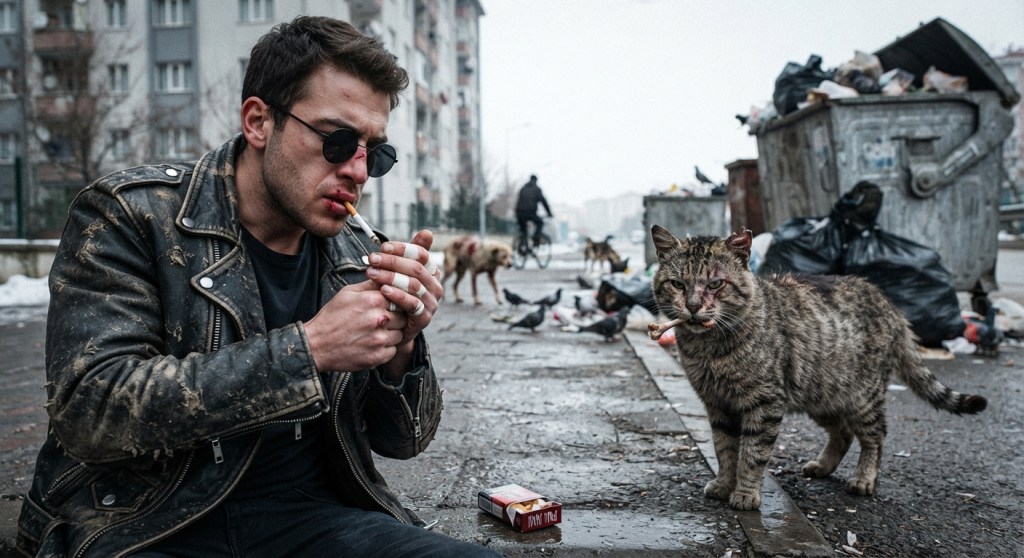
It was the beginning of winter. I sat on the curb, leaning back, my right elbow resting on the pavement. I patted the large, silver-toothed zippered pockets of my black leather rider jacket—its collar and cuffs frayed, its color long since lost to rain, dust, and sun—and found a Pall Mall pack with four or five cigarettes left. I managed to light one despite my broken fingers, tucking it between my split lips. Across the road, around an overflowing municipal dumpster that the city couldn’t be bothered to empty, the neighborhood’s animal kingdom was eating whatever fell their way, in a fragile truce with death. The dogs ate the stale, moldy bread; the sparrows, doves, turtles, and rats ate the crumbs that fell from them; and the cats ate the scraps left on the chicken bones. Some of the cats were missing an eye, others a tail; a dog had chunks of its fur ripped out, with large, open wounds on its skin and nose. The rats and birds were most likely infected; some wouldn’t make it through the evening. If they had offspring hidden somewhere nearby, they would either fall prey to something or starve to death, and no one would ever know.
My phone buzzed in my pocket; I figured it must be Sismique. I wasn’t answering, and I probably wouldn’t. I didn’t think I could explain to her why my lip was split, my fingers broken, my ribs cracked, and my nose scratched just yet. A local acquaintance, known for their constant questioning, rode by on a bicycle and startled a few birds; the cats and dogs couldn’t have cared less. I wiped the blood from my lip with the inside of my wrist. Putting on my round-framed sunglasses that hung from the neck of my black t-shirt, I snapped, “Fuck off, go mind your own business!” They left. What happened to me only concerned me and Sismique; I would tell her when I found the strength to, when it became a story that could be told. Until it is told, no one will ever know.
Bektaş appeared from around the high-rise building behind me, moving with a crab-like gait. He had a deep wound on his right front paw and a scar from the past on his hip. Half of one ear was missing, another diagonal scar ran across his face, and the last fifteen centimeters of his tail were broken, dangling like a clock pendulum from a time we weren’t in. He was thin. He was terrifying. He didn’t have to do anything to be feared. His demonic eyes, set in his massive head, and his deliberate, life-dividing stride, taken as if he had no complaints despite the open wounds all over his body, were enough. Though people call the patterns on tabbies “the Prophet’s fingerprints,” Bektaş looked like he’d only been caressed by gods of war. Still, no one ever knows who caresses whom with tenderness.
When he reached the edge of the sidewalk, Bektaş was about ten meters away from me. He looked first at the pile of trash across the street, then turned his head to look at me with pity. My phone rang again. Sismique, again. I was still thinking about what to say, but more so about what not to say. I’d left the house happy; Sismique was happy. Then something happened, an unprovoked tremor inside me. When a person collapses from within, they can’t find a safe triangle to shelter in; everyone knows that. A person has to run, to find refuge far from themselves. I had sought refuge in violence and alcohol at a bar and had survived. Sismique was an amazing woman, even if she created earthquakes inside me that left behind wreckage every single time. People, like nature, leave wreckage in their wake; the greater the wreckage they leave, the more they know their own self-worth. An earthquake destroys a city, but no one knows how the earth measures its own power in that moment.
The moment he placed his front paw from the curb onto the road, the false peace around the dumpster gave way to a chaotic hell. Bektaş’s broken tail signaled that it was time for destruction for that fragile truce around the container. Bektaş stepped into the street like one of Istanbul’s heavy-hitting mobsters; as he lowered his other paw, his shoulder blades became distinct. He walked across the road like a moving shipwreck. He took a single chicken bone from the trash heap—where not a single living creature remained and where the animals that had just been feeding had scattered in every direction—held it in his teeth, and continued on his way. A single bone was necessary and sufficient. I answered the phone. “I didn’t want to leave without telling you,” Sismique said. “I’m afraid of you.” There was nothing to say; every earthquake leaves wreckage in its wake, every fire leaves ash. In nature, all animals are wounded; everyone knows.

