Beneath the warm yellow sun in the blue sky and clouds resembling a scattered flock, the lush green meadow, adorned with daisies and poppies, stretches as far as the eye can see. Upon it, swallows, bramblings, zebra finches, sparrows, mice, and countless others stand as the noisy yet mute witnesses to the silent ceremony unfolding before them. Beneath the wooden archway adorned with red roses and tart apples, the gaunt, unsightly man in a black tailcoat offered an uneasy smile to the beautiful woman. She wore a black veil and a black French lace wedding gown, embroidered with crimson fire blossoms, that embraced her entire body. Without ever tearing his eyes away from her black veil, he said, “Yes, I do.” He took off his tall top hat, tucked it under his left arm, leaned in slightly, lifted the veil from the woman’s face, and kissed the tip of her nose.
Not a single applause, not a single congratulation… Only silence.
Mr. Autrom checked his watch: 00:00.
The beautiful bride in black plucked one of the apples from the archway, took a joyful bite, and then, with mischievous delight, brought the apple to the ugly man’s lips.
Along with his wife, Mrs. Apsev, they moved into a spacious, detached house in Kızılçayır, surrounded by red rosebushes, with a fig tree, a sour cherry tree, and a hackberry tree gracing its front door. Kızılçayır was a plateau blanketed in waist-high crimson grass that stretched as far as the eye could see, utterly devoid of any other dwelling besides their own. Not even the cold visage of the neglected cemetery a few hundred paces away, overgrown with local weeds, could deter them from buying this house.
Both of them loved the house dearly. They hung pictures of horses and children on the river-foam-colored walls. In the stable near the house, they also tended to twelve horses—six black and six white—cherishing them as the apples of their eyes.
Mr. Autrom and Mrs. Apsev, who carried their third child in her womb, would often go picnicking together in the meadow before them. As they quietly drank their wine on the blanket they had spread among the grass, Mr. Autrom checked his watch. 00:00.
“Let the little one’s name be Natan,” said Mrs. Apsev, caressing her belly.
Suddenly, clouds veiled the sun.
“A beautiful name,” Mr. Autrom agreed, placing his hand over his wife’s hand on her belly. He smiled as he whispered the names of their children into her ear: “Neven, Menis, Natan…”
As the clouds shrouded the sky, Menis, who had been gleefully chasing mice among the grass, could no longer be seen; only her voice could be heard.
“What time is it?” asked Mrs. Apsev, as if they were in a rush.
Unable to bear their own weight, the first heavy drops broke free from the clouds. The sky joined in with a deafening roar and flashes of light to the melodic rhythm created as they struck the picnic basket, the checkered blanket, the crimson meadow, the leaves of the perhaps infinitely old Turkey oak, the wings of short-eared owls, plovers, and shrikes, the crimson grass, and the dormouse fleeing from Menis.
“The same,” said Mr. Autrom, looking at his watch.
Mrs. Apsev’s eyes caught upon a poppy among the tall grass, waiting helplessly like a bloodstain for the raindrop destined to fall upon it.
“It will stop soon,” she said, lifting her gaze slightly to the sky.
Gathering old rags to maintain the diligence carriage after the rain, Mr. Autrom and his daughter Menis meticulously wiped away every droplet on the vehicle, occasionally exchanging smiles. When their work was done, the three of them lay down among the wet grass to rest under the sun that was beginning to peek through the clouds. Menis, alternating between bursts of laughter and sheer excitement, joined her mother in likening the clouds to animals. First a horse, then a sheep, then a snake, and the next a scorpion, she declared. As she listed the animals, her wheat-colored skin seemed to darken, her brow furrowed, and she hissed the word ‘snake’. When she grew bored of the clouds, she began to recount entirely fabricated tales aloud, with grave attention and seriousness. Right in the middle of a story, Autrom suddenly sat up and brushed himself off with his hands. He retrieved his tailcoat and hat, which he had rested on the carriage’s leather-clad seat. Draping his coat over his arm, he pulled out his watch and checked the time: 00:00. He called out to his daughter, who was still lying among the grass, weaving her tale.
“It is time to go, Menis.”
They headed back. Opening the white garden gate, fashioned from carefully nailed battens, Mr. Autrom stepped aside to let his pregnant wife, Apsev, who was carrying the picnic basket, and his daughter enter the yard.
“I’m going to check the mailbox,” he said, adding, “I’ll be right back.”
As Mrs. Apsev stepped into their home, she glanced back and bestowed upon Autrom a smile so beautiful that, for no apparent reason, Bay Autrom felt a sudden thunder echo within his chest.
Closing the garden gate and taking a mere twenty-five steps down the path connecting to the main road, Mr. Autrom retrieved the only envelope bearing his name from the box. Muttering that he would read it later, he slipped it into his coat pocket. He took twenty-five steps back and arrived at the garden gate.
Though he noticed that the ragged, leafless rosebushes bore not a single rose and that the trees were on the verge of dying from neglect, the man felt no stirring of curiosity. He stepped inside the house and called out the names of his wife and children one by one. The collar of his shirt had begun to constrict his throat; he wanted this silence to end. Walking slowly through a home he could barely recognize, listening to his own breaths, Mr. Autrom stood like a tombstone dead center on the red rug in the living room. For a while, with eyes forged from pure agony, he stared at the smiling faces of his family in dusty frames on the walls, the glass of each pierced by a single bullet hole. Only then did he reach into his pocket to pull out his watch. As the metal casing of the timepiece resisted breaking within his clenched fist, blood escaped from between his fingers and dripped onto the floorboards: 00:00.
The wooden door of the house creaked open. Mr. Autrom took one last look from the porch at the withered trees, the crumbling plaster of the walls, the abandoned swallows’ nests in the eaves, and the spiderwebs. It was only when he thrust his freezing hand into his pocket that he remembered the letter.
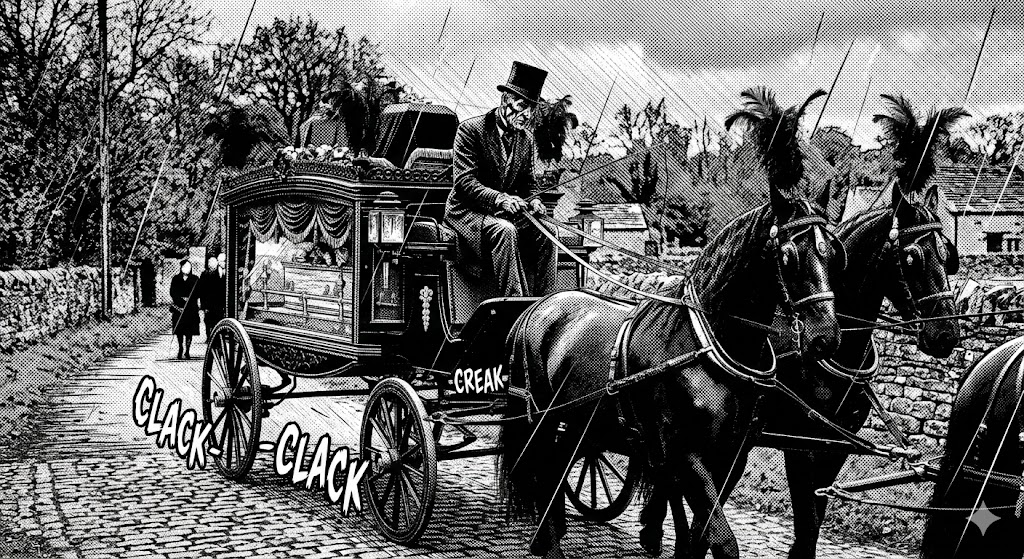
His brow furrowed as he read the sender’s name on the yellowed envelope; his eyes welled up with tears, and he sniffled. Tucking the unread letter back into his pocket, Autrom headed to the stable, brought out his horses, and hitched them one by one to the tongue of the stagecoach. Climbing into the driver’s seat, he grabbed the reins and commanded his horses, “Giddyap!”
The time: 00:01.
Yazan: Chaotica
Çeviri: Umberto

