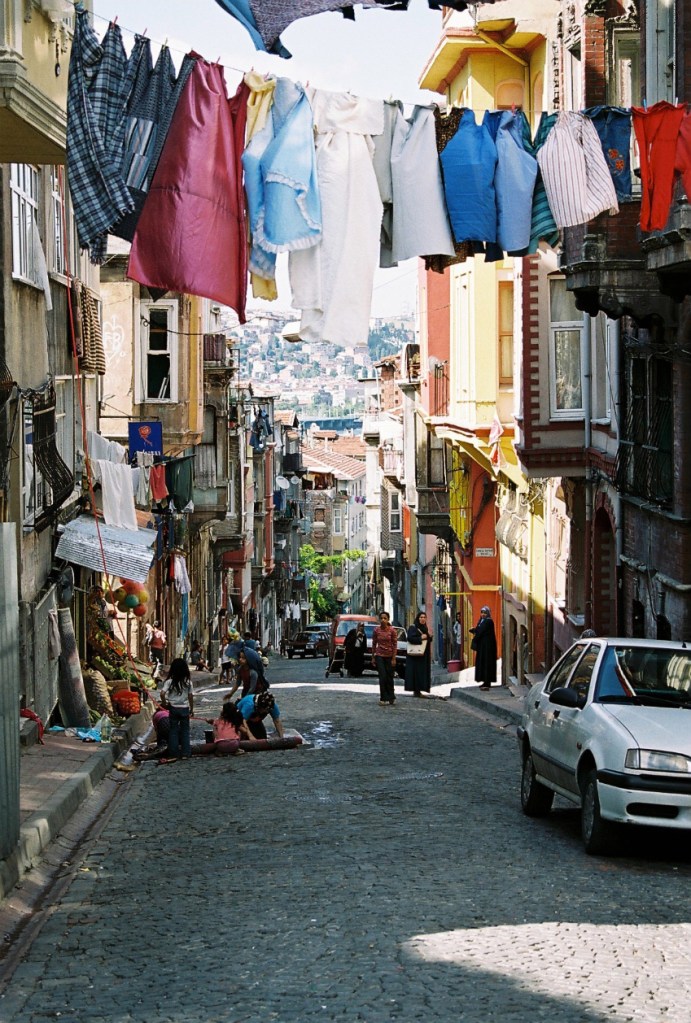
The neighborhood youths were gathered in front of Şükrü’s Grocery, staring at a string held at one end by Adnan, amused by the sewer rat tied by its tail to the other, making futile attempts to escape. The rat would dart right—no luck; head left—no luck. Every time it tried to scramble beneath someone’s feet, the youths would jump back in excitement, and Adnan would burst into laughter, yanking the string back.
Nothing important was happening. Nothing ever did. Sister Suna had drowned a week after caressing my head in the grocery shop and enchanting my little soul by saying, “Brother Şükrü, give this handsome boy a biscuit, will you?” The man she loved hadn’t saved her—or couldn’t save her. He was married, and he hadn’t come to Sister Suna’s funeral either—or couldn’t come. Instead, his rumor came.
“May God forgive her sins!” my mother had said.
“Amen!” said Aunts Emine, Mevlüde, Badem, and Kaymak…
I had seen the steam rising from behind the bedsheets hung on lines as curtains. And the shadows of the women. They were washing Sister Suna. She was a beautiful woman.
It was a neighborhood where gossip happened during the event and immediately after; no topic was ever stretched out, and if it was, it was closed with the warning, “Eeeh… this topic’s stretched thin like worn-out elastic!” Insignificant things always happened, after all.
“Brother Şükrü, open an Elvan soda for me!” Adnan called out.
We all heard the cool “Fssss…” sound echoing from inside the shop.
Holding the bottle against his belly, his thumb capping it to keep the fizz from escaping, Brother Şükrü stepped out. Mindful of the rat, he handed the soda to Adnan and joined the audience.
It wasn’t something worth talking about. The strings were in Adnan’s hands. Maybe for the first time, and he clearly wanted to savor it as much as he could.
They had thrown Brother Ömer in jail for stealing pigeons. Auntie Türkan, her market bag stuffed with supplies, quietly headed toward the prison behind the crowd. As she passed by, she gave me a warm, full smile. I had gone to the women’s bathhouse with her once. I had eaten a biscuit softened by the steam and could never get that same taste from any biscuit again. Maybe it was the lack of white soap, or maybe the lack of the scent of a white woman… I don’t know.
“Study hard and become an engineer, my big-headed boy,” she said, stroking my cheek. She was an Ethiopian immigrant. They had arrived long ago. She was the Black woman of the neighborhood; I wasn’t afraid of her, but she made me uneasy. Not because of her skin color, but because of her short, curly hair. Actually, not even because of that… but because I thought the term “tangled mess”—what we called Arap saçı—was something terrible. It wasn’t actually terrible. It was just entanglement. A mess, like the whole of society… A tangle one could either tolerate or complain about.
When a fishing line got tangled, we would throw it into the sea. The line would untangle itself out there. It was like magic. Years later, before Maya and I went our separate ways, that tangle was one of the insignificant things we talked about.
“Let’s throw our relationship into the sea; the sea will find a way to untangle it,” I had told her. We threw it into the sea of time, and it untangled. To separate is sometimes to be untangled; a mess, on the other hand, is the sole condition for staying together.
Adnan left his empty bottle at the base of his house’s yellow garden wall. His father, Uncle Lütfü, appeared at the white garden gate behind him. Uncle Lütfü was a cobbler and used to call the shoe glue solüsyong instead of solüsyon. Since I first heard the word from him, I pronounced it that way for years. You can’t always trust grown-ups.
His father’s feeble glare must have had a strong effect on Adnan, because he decided to end this insignificant show. Swinging the string, he began slamming the rat tied by its tail against the yellow wall repeatedly. We could all hear the rat’s faint squeaks. The yellow wall was bleeding. When the sound stopped, they understood the show was over. Brother Şükrü picked up the Elvan bottle from the base of the wall and went back into his shop; the youths dispersed, and Adnan disappeared behind the garden gate following his father.
I was left alone on the stage. I approached the rat’s carcass. It just lay there at the base of the wall. I had learned from the neighborhood kids to spit three times on animal carcasses.
An insignificant detail: I didn’t spit.

