As Nityez wound the white wool in Kumap’s arms into a ball, the skein between his hands turned black with every loop.
The twins—now eight years old—had been born on the day their mother died: one albino, the other black as pitch. Their grandmother had taken the babies to her cabin in the Sonava Forest and raised them there. When they turned six, she had set them loose in the woods. If they came home now and then, she would give them each a bowl of food and spread a mattress for each of them in the little hut she had built in her garden, a garden divided between winter and summer.
No one knew who their father was, though rumors were plentiful. Some said he had been a stagecoach driver. Others claimed he was one of the passengers. There were stranger stories still, but no one had ever come forward looking for the children.
The old woman had noticed that the twins were unlike other babies from the day they first learned to walk, though she had never been able to make sense of it. Wherever Kumap stepped, life sprang forth. Wherever Nityez walked, a snowstorm followed. The ground froze beneath Nityez’s bare feet; beneath Kumap’s, daisies, poppies, and grass came alive.
Sonava had been split in two: one side winter, the other spring.
Under the trees, the children wound wool into balls and gathered them in a basket they had woven from branches. That was when a dirty bandit came up behind Nityez. He was broad-shouldered and bearded, wrapped in a bear skin, with deep scars carved across his face.
Another man, dressed in a fine linen shirt and trousers, appeared behind Kumap.
At the same instant, the two bandits clapped their hands over the children’s mouths and pressed knives to their throats.
Nityez let his ball fall. Kumap dropped the skein at his feet. Neither resisted. They surrendered to whatever fate had found them.
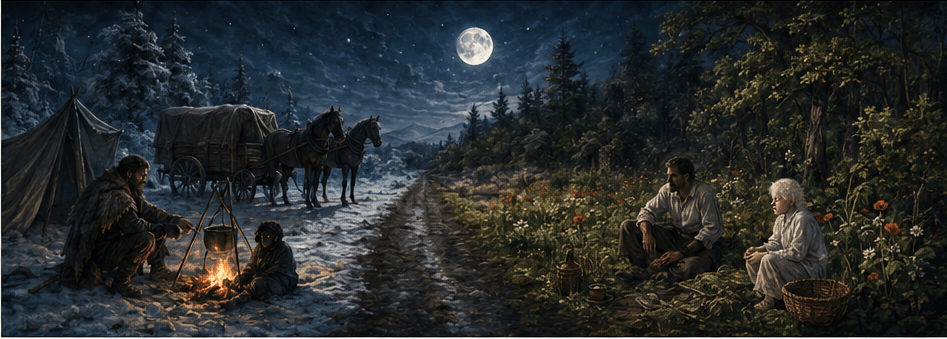
Their hands were bound tightly behind their backs, and the children were thrown like sacks into the back of a wagon drawn by two horses. The wagon stood upon the road where winter met summer—one wheel rolling through snow, the other through spring.
“They’ll pay well for these in Edgin,” the bear-skinned bandit muttered from the driver’s bench as he cracked his whip. The horses fell into an easy trot.
Spring divided the road down its middle. On the right, blackberry bushes, tar junipers, nettles, and rosehips offered a colorful feast of things to nibble. On the left, the cold and profound gloom was made darker by the cries of crows and magpies circling overhead, sometimes squabbling in midair.
After traveling for a long while, the bandits stopped the wagon as darkness began to fall.
They climbed down and checked that the children were still alive. A cloak, gray with dirt, had been thrown over them.
The twins showed no fear—not of being taken, nor of the coarse hemp ropes that cut into their slender wrists.
The bandits let them drink from their leather water skins. Some of the water trickled from the corners of the children’s small pink mouths and ran down their necks. The drops that touched the collar of Nityez’s black smock froze instantly. On Kumap’s white smock, the same drops evaporated within minutes.
One of the bandits pitched a tent on the snowy side of the road and built a fire. He lifted Nityez from the wagon, carried him gently to the flames, and laid him down. Then, to keep him from escaping, he tied his feet as well.
Before the night grew completely dark, the man went hunting for their supper.
The other bandit stayed with Kumap. He had climbed down from the wagon along the way and shared with the boy the little things he had gathered for himself—berries and other small snacks. From herbs stuffed into a leather pouch, he brewed them a tea.
“Why are you so white?” he asked Kumap. “I swear I’ve never seen anything whiter in my life. And you’re clean, too. I’m sure they’ll pay good money for you in Edgin. You’re good with your hands, aren’t you?”
“If they want wool wound into balls, I can help them,” Kumap said.
The bandit smiled.
“So—if they want wool wound into balls,” he said. “I suppose they couldn’t expect much more from someone as small as you.”
When the other bandit returned carrying a dead rabbit and some firewood, Nityez was still lying beside the fire, black as a good coal.
The man skillfully skinned the rabbit and removed its entrails. He threaded it onto a branch and roasted it over the flames. Then he divided the meat between two dirty metal plates he had taken from the wagon and untied Nityez’s hands.
The scars on the man’s face seemed to dance in the shifting firelight.
“Eat.”
He held the plate out to Nityez.
Nityez took it and placed it before him. With his small fingers, he began tearing the meat apart, separating it from the bones.
“I’ve never seen anything as black as you in my life,” the bandit said. “If it weren’t for your eyes and teeth, no one could see you in the dark. I’m sure they’ll pay good money for you in Edgin. You’re good with your hands, aren’t you?”
“If they want wool wound into balls, I can help them,” Nityez said.
He lifted pieces of rabbit to his mouth, chewing in silence as he listened to the man.
When they had finished eating, the bandit tied Nityez’s hands again and carried him into the tent. To keep the boy from freezing during the night, he covered him with the dirty cloak from the wagon.
Then the man curled up on the snow beside the fire.
Kumap and the other bandit lay down on a bed they had made from herbs.
On the left side of the road, snow began to fall.
On the right, beneath a deep-blue night, the full moon shone above the majestic trees of the Sonava Forest.

