Behind the glassed booth that resembles a theater box office, a redhead girl in her twenties with freckles is playing with her phone.
She smiles to herself; then, with her thin, delicate, almost translucent white thumb, she swiftly replies to the message that tickles her amusement on the touch screen. Her fingernails share the same pale whiteness as her hands.
I tap on the glass. She raises her head, scowls at me as if I were an unnecessary citizen interrupting her work, turns back to her phone, and finishes her text.
“May I help you?”
She looks at me as though she is performing the most burdensome chore in the world and I have just loaded all its weight onto her shoulders. She carries that indifferent, cold anger of people who surrendered their joy for living long ago.
Leaning toward the oval opening of the glass partition, I place my right hand on the counter. Tapping my fingertips rapidly against the surface, I compose the shortest possible sentence in my mind.
“If it suits you, I’d like to rent this place for tonight, until morning. There will be one other person besides me. Could you please show me around?”
She rolls her eyes, making her desire to avoid any futile effort palpable. I pull a stack of cash from my pocket and lay it in front of her.
“This is just for the tour… If I like it, we’ll talk about the price.”
Her rolled eyes come back to life. Taking the money, she stands up, steps out of her small booth, and leads the way.
“It’s going to snow heavily tonight, Sebahat,” I say.
“My name isn’t Sebahat, sir, and besides, it’s June,” she replies with sharp bewilderment.
“Anyone who isn’t Kamuran is Sebahat, Sebahat. Besides, clouds do not recognize months; whatever must fall, falls. Sebahat!”
Uneasy, she falls silent.
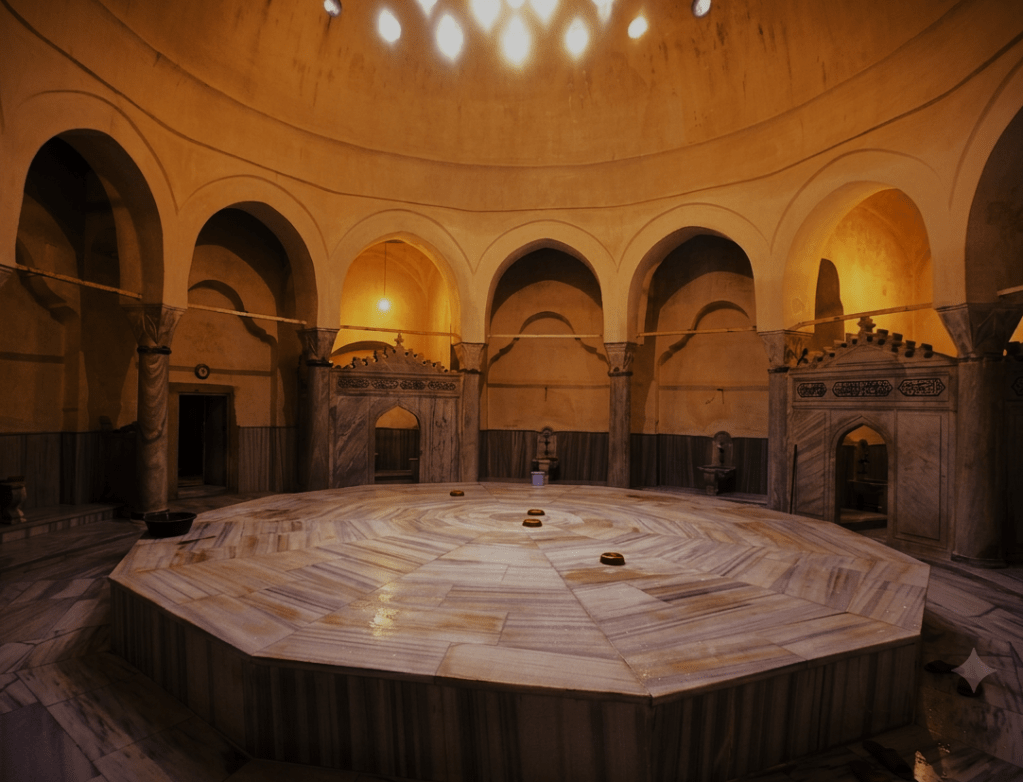
We pass through a narrow corridor into a vast space. Circular windows cut into the dome, the central marble warm-stone, marble basins tucked along the base of the walls, Ottoman-crafted fountains, intricately decorated tiles…
“Would you stand in the middle of the warm-stone and sing a song, young lady?”
Hesitantly, she fixes her eyes on mine. I pull another thousand liras from my pocket. She walks toward the central marble stone like a lead soloist whose turn has come to take the stage.
“What would you like me to sing?”
“La vie en rose. It’s Kamuran’s and my song. Can you sing it?”
“I don’t know that song,” she says, looking at me with coy, apologetic eyes from the center of the marble platform.
“Just start,” I say. “I am sure you can sing it.”
Astonished at herself, she sings the song flawlessly in the unmistakable voice of Édith Piaf. I draw a filterless cigarette from my case and light it. Listening, I let the tears fall freely down my face.
I remind the driver that we shouldn’t be late. Kamuran smiles as she takes a sip of cognac from her glass.
“People have gone mad tonight, Chao!”
Outside, the city is in revolt. People clash with the police; the sounds of tear gas canisters and rubber bullets blend into the chanting slogans. Up ahead, a car burns in the middle of the road; bank branches are targeted by Molotov cocktails.
“Why are people so tense, Chao?”
“By morning, everything will be over, Kamuran. They will wake up to a sunny, clean dawn.”
“So why now?”
“Most mornings, you wake up tense too, Kamuran. The people have simply awoken.”
“I love people who wake up at midnight, Chao.”
“I don’t like people who wake up late, Kamuran.”
She smiles. She smiles so beautifully… Beautiful as a rebellion, beautiful as a revolution…
When we arrive at the bathhouse entrance, the driver opens Kamuran’s door first, then mine.
“Good nigh—”
Before the driver can finish his sentence, a stray bullet strikes his head. As he collapses at my feet, my face is washed in his blood. Kamuran smiles; I smile back.
“I love you, my miracle,” I call out to her.
She extends her delicate hand toward my lips for me to kiss. I kiss it. A stain of blood left by my lips rests upon the back of her hand…
Sebahat is busy with her mobile phone in her little booth. I tap on the glass. Catching sight of my bloodied face, she gasps in horror and rushes out of her counter.
“It’s terrible outside, sir! I was just watching it on my phone—”
“Is it ready, Sebahat?” I ask, cutting her off indifferently. She nods in affirmation.
“Until morning, Sebahat,” I say, looking straight into her eyes. “The uproar outside will not cross this threshold. Remember that!” My hand caresses her cheek. “Soon thunder will rumble, and the snow will begin. The blood outside will be covered. Don’t be afraid; we are here.”
She nods. I leave several wads of cash on the counter from my pocket.
Step by step along the corridor, Kamuran sheds her clothes. Her shapely, tattooed back is like a fairground—the dreams of a child, the memories of a schizophrenic, the fantasies of a housewife…
When she enters the hall, she is no different from a goddess.
Laying upon a loincloth sheet spread beneath us, we recline on the central warm-stone, captives of a peaceful exhaustion. Thunder rumbles, and the snow begins to fall. After the last bombs explode outside, the city settles into a profound silence.
I draw a hit from the hashish hookah and exhale it from my lips into her lungs. She fills her mouth with raki and pours it from her lips into mine…
“Why?” she asks.
“Because,” I say, “had God brought us together any earlier, we would have parted so grandly that we could never reunite. And that wouldn’t have made you Kamuran, nor me Chao.”
“You don’t know how much it hurt to be apart from you.”
“I know. I bore that pain every single day.”
“Was it so that we could mature, Chao?”
“We have matured; we have reached fruition in one another, Kamuran.”
“Is it time?”
“It is time to part from our branch without snapping it. A fruit that has ripened must be severed so it does not harm its tree.”
I draw the straight razor from under the sheet. She extends her wrists. On both, I skillfully locate the veins and gently cut top to bottom. Then, I cut my own wrists…
Turning on the hot water, we sit between the rows of marble basins, watching the large snowflakes fall through the dome’s circular windows.
How quiet the city is… Kamuran sings.
Tomorrow will be a fine day; beautiful as a tree properly pruned.

