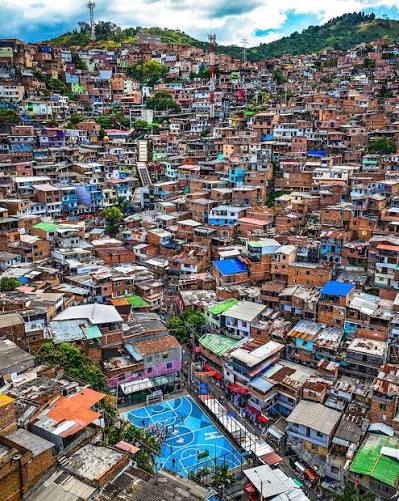
We are in the more derelict of two shanties occupying the same yard in the Tuzluçayır neighborhood. A wooden door that resembles the entrance to a barn—standing open by just a few inches—is secured from the inside with a motorcycle chain and a padlock.
In the single-room dwelling behind that door, a woman curls up on a heap of clothes she has laid out as a makeshift bed. Wearing a torn jersey pajama bottom soaked in her own urine and menstrual blood, knees pulled tight to her chest, she sways back and forth. The reek of a dead cat she sits staring at burns the nostrils of a man in a military jacket—a man driven mad with rage, currently kicking, pounding, and throwing his shoulder against the door. Another bout of frenzied Ankara rain frightens the residents of this ancient neighborhood, at least a millennium old, which the municipality has sworn to demolish, alternating between cracks of thunder and flashes of lightning.
“Open the door, Kamuran! Kamuran, baby, open this door! If you don’t, I’ll have to break it down!” the man shouts before throwing his weight against it once more.
He hears a faint groan: “Get out of here, Chao!”
“What do you want from me, Kamuran?!”
“I want you to bring me what I asked for, and I want you to kill me.”
“I’ve killed us three times already, woman! It doesn’t work, don’t you see? We don’t get any better. Just let us live…”
“Get out of here and never come back, you murderer! You murderer of death!”
Chao is well aware that he smells like a wet carpet. There is no part of him left that he cares to keep dry; exhausted, he sinks to the ground in front of the door. He feels a volcano beginning to take shape within him, yet he tries to maintain his composure.
The streetlamp outside the other shanty in the yard flickers to life. Uncle Basri, a man in his sixties with broad shoulders and a straight posture, steps out onto his porch in a striped pajama bottom and a white undershirt.
“I’m ashamed of myself and my family for letting you people stay here! Clear out of my house this instant! You filthy junkies! I have a daughter living here; every single day it’s fighting, every day it’s noise… What on earth is this?!” he barks angrily toward Chao’s silhouette, which he can barely make out in the dark.
“Go back inside, Uncle Basri. Don’t get involved. You’ll catch a cold.”
“Listen to this scoundrel mocking me! Wife, bring me my phone, I’m calling the police!” he calls into the house.
Chao pushes himself up and reaches inside his jacket, placing a hand on his waist.
“Go back inside, Uncle Basri. Close the door, you’ll catch a cold. And if the police show up, the fire at this door will spread to your house, too.”
“Are you threatening me, you pimp?! Take care of the woman inside first if you call yourself a man!” After saying this, he calls into the house once more: “Sebahat! Bring my shotgun, girl, hurry!”
Although Chao thinks this threat is mere bluster meant to scare him, the moment Basri’s twenty-something daughter appears at the door holding a shotgun, he realizes he has a choice to make. The rain pours harder; lightning cracks across the sky.
Chao pulls a handgun from his belt and pulls the trigger twice in rapid succession. The sound of the gun vanishes into the roar of the thundering sky; the red flash of the muzzle flare is swallowed up by the darkness in the blink of an eye.
When Basri’s wife sees her husband and daughter lying in the hallway with bullet holes in their heads, she scoops their heads into her lap and begins to wail. But with the third and final pull of the trigger, the old woman follows her family into the quiet. Chao stands at the threshold, taking in the family: Basri, the retired laborer; Mediha, the housewife; and Sebahat, the freckled redhead who had just gotten engaged last month…
He drags them inside, switches off the light, and pulls the door shut. After pausing a moment to consider his next move, he slams the crooked garden gate behind him and melts into the streets of Tuzluçayır.
An Hour Later
“You ask me a question, Kamuran, and then before listening to my answer, you either walk away or block my number… That’s what I hate.”
Kamuran shrugs, answering with cold indifference: “You deserve it.”
“Because I care about you?”
“Maybe!” Her eyes fixate on two syringes filled with enough heroin to fell a horse. “Does it matter?”
“It does. We’re going to die in a moment. I don’t want to die without knowing.”
“We’ll be resurrected. Even the ones you killed will come back… Sebahat, Uncle Basri, and Sister Mediha too…”
“The cat, too,” Chao finishes her sentence. “But we’ll wait for years. We’ll be children, teenagers, adults… I’ll set out on the road just to meet you again; I’ll hunt down your trail; I’ll bring all the components of death and life back together. Just so you might choose to live with me.”
“And if I still don’t?”
“I’ll come after you again. Maybe knowing this will help me solve this equation.”
“I think what makes you love me this much is the rage you’ve carried inside you for over a century. Your tenderness, your lust, your longing—they all feed on your rage. I’m afraid that if I don’t make you angry, you won’t love me.”
“We have hearts big enough to love everything, Kamuran, but we only have the courage to try again and again for very few things. It isn’t rage that drives me to find you every single time.”
“I know. Your love is diseased. You love even when all doors are closed, even while waiting to be reborn. Maybe that’s why you’re so impatient; you run headlong toward death just to live life quickly, get it over with, and be with me again. Chao, I love you.”
“I love you too, my miracle.”
“You know I can’t do it,” Kamuran says, extending her leg.
Chao fastens the tourniquet around Kamuran’s pale leg.

