There are moments, Zerre, when anyone can lose their humanity. I find mine every now and then. It is obvious that the pelt I wear resembles a human; yet I do not know which beast lurks inside. Sometimes a cat, sometimes a rat, sometimes a dog… Very well, Zerre, I won’t speak of my beastliness. I will tell you of a moment when I was unequivocally human, of what happened before I came here.
The seven hundred dollars in my pocket felt reassuring, yet I was as far from my dreams as two polar circles. What kind of madman wedges an entire world between himself and his dream? Converting that seven hundred dollars into Turkish Lira meant I could buy plenty of alcohol, weed, sauces, sugary drinks, expensive nuts, and fried chicken, and consume them all in front of the television. I could have linked Montesquieu’s observations on climate and geography’s impact on human culture with dialectical materialism; I could have immersed myself in Foucault’s analyses of power. Foucault fascinated me when he said, “A good truth-teller who gives you honest advice about yourself neither hates you nor loves you.” To me, the primary condition of telling the truth was likewise carrying no emotional obligation or self-interest. That was why I only loved certain living beings I knew directly, hated some, and felt nothing at all for the rest. To my mind, expressions like “love for humanity” or “love for animals” were the greatest lies ever invented, right after religion and the state. I suppose I was contemplating buying some books.
The war ignited by the lazy people of the hot and arid climate sparked a massive wave of migration. The descendants of the Assyrians abandoned their lives and fled to Anatolia. The fear of death and the instinct for self-preservation… I suppose nothing compares to it, Zerre. Nothing! A person’s profession, religion, nationality, and property are merely the shields they construct to protect that core. When the core is directly threatened, a human is no different from a rat in the street; the drive to preserve the species overrides everything else. Yet Rousseau had beautifully summarized the absurdity of believing that property offers protection: the first fool who enclosed a piece of land and declared, “This is mine,” became the founder of civilized society’s ruin. Had someone stepped up, torn down those fences, and cried out, “The fruits belong to all, and the earth to no one!”, humanity would have been spared countess wars and murders. But it didn’t happen. The refugees are everywhere now. In the eyes of the Anatolian people, they wander as a dishonorable and cheap labor force; picking up scrap paper, selling tissues, working as porters, or dreaming of escaping further west on a burst inflatable boat.
As I approached the Clock Tower, at the foot of the ruined fortress walls, a skinny young man with a long mustache suddenly appeared before me, accompanied by his dark-skinned, physically striking wife—still wrapped in a mourning scarf—and their baby in her arms. Far Eastern tourists were prowling like a pack of starving dogs left out in the frost, hunting for something to frame in their lenses. My mind was set on rushing past this place, escaping into man-made alleyways devoid of people, their scents, and their laughter. The young man pulled a paper tissue from a crumpled grocery bag, held it out, and said something in a Semitic language. I paused and appraised their helplessness. The smell of hunger is revolting, the smell of sweat, disgusting! I fear we will never comprehend that we are nothing to the universe, Zerre. There was no need for all this pain. There never was.
Lowering his tissue-holding hand with my left, I thrust my right hand into my pocket. I pulled out the folded dollar bills; raising three hundred-dollar notes toward his face like playing cards, I looked at the woman. She took a step back and hid behind her husband. I wanted to see the fire of rage ignite in the man’s eyes. His eyes gleamed, but not with anger—with the desire to bargain behind a mask of faux embarrassment. He stepped aside for me to take the woman. As she glared at her husband with eyes shooting sparks, the man looked at the child in her arms. Thus, the last remaining shell was peeled away to reach the human core. The man was doing this for himself and the continuation of his lineage. He shed his wife like a dried-up scab. I handed over the money. Taking the child from the woman’s arms, the man pointed toward the Clock Tower and said something; he was likely describing where they would meet once I was done with her. They left.
I was left alone with a scab peeled from someone else’s wound. As I walked, she followed a few paces behind me. I didn’t speak, I didn’t look back; I only made sure she remained within my line of sight. We returned home with a transaction short of what I had planned.
We still live in a world where it is believed one must sleep with a woman who has been paid for. Women have always been objects, and they still are. Were it not for the social order, they would be subjected to far more brutal treatment. The fact that mankind—evolved from water and soil—attributes sanctity to copulation is the root cause of this brutality. Even in Africa or among the most primitive tribes of the Amazon, the performance of rituals for sex shows that holy books are not the origin of the sexual taboo. On the contrary, sex is the very reason holy books exist. While one portion of humanity demonizes sex at the cost of the species’ extinction, another glorifies it. As women gain sexual liberation, both genders sever their ties with religion. Still, we have a long road ahead.
I motioned for her to undress. As she bashfully undressed, she tried to turn her back; I stopped her. I wanted to see her face. It is difficult to persuade a woman—who has been shamed into dressing and undressing in front of a husband she has slept with countless times—to strip before a stranger. But I had paid for her; she had to do it. Her deep brown body was flawless, save for a scar or two. To possess a skin so close to black… It was as if their bodies had assumed a natural color of mourning due to the sheer abundance of death in their geography. This was the role God had cast for them. The straight, jet-black hair that cascaded down when her black headscarf was removed; her breasts like glistening black tourmaline, her vagina, revealed as her black skirt and embroidered blouse slipped away… Women born in the color of mourning, just to mourn…
I sat down in my armchair of nothingness and turned on the television. I rolled a cigarette and lit it, then opened a cola. She stood beside me self-consciously, waiting for me to fuck her. She whispered things now and then, but it carried no meaning. I didn’t understand a fraction of what she said. She tried to cover her face with her long hair, her breasts with her forearms, and her private parts with her hands joined in a V-shape. She couldn’t hide the sunken hollow of her stomach. I wasn’t bothered. I would tend to her in a moment; first, I wanted to finish my cigarette.
When I felt my head reach the right state, I stood up. My mind was at its sharpest. Taking her by the shoulders, I moved her next to the right side of the TV hanging on the wall. She accommodated me with hesitant steps. I stepped back and looked; it wasn’t right. When I placed her by the corner, she disappeared behind the door. I had to change her spot. I pulled her toward the back of the sofa. I went to the living room doorway and looked from there. Her position was as beautiful as she was. I motioned for her to get dressed. She was bewildered—surprised with a mix of relief, sorrow, and offense. Sleeping with a woman or desiring her shouldn’t be the only way to make her feel beautiful! Her taking offense because I didn’t desire her was absurd. The thought of sex with strangers has always unsettled me.
We ate a bite together in the kitchen. I prepared it, she cleared it up. She tried to avoid eye contact as much as possible. She put on her shoes, and we left the house together. I wanted to confront her husband by the Clock Tower. Both remorse and rage were written plainly across the man’s face. The blanket of the child in his arms was crumpled inside his clenched fist. Before I left their side, having seen what I needed to see, the man thrust the child back into the woman’s arms.
Suddenly, I felt a burning sensation in my calf. Without that nearest scab, the man had grown cold; three hundred dollars hadn’t been enough to warm him. He had likely blamed me under the weight of his loneliness.
As I pulled the knife from my leg, I saw the man’s crazed eyes. A madness born from the fact that he could never be certain of what transpired between his wife and me… My leg will heal, Zerre, but his doubt will one day crack his skull open.
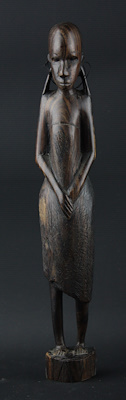
Bleeding amidst the strange gazes of timid and indifferent people, I came here, to you. I have made my decision: I will place that “Bashful Woman” statue you carved for me out of ebony right behind the sofa. It will look best there in my living room.
Can you stitch this wound, Zerre?

